Annealing Nylon 6/10
Synthesized Nylon 6/10 by interfacial polymerization, annealed segments from room temperature to 200 °C, and broke them to find where tensile strength peaks.
3D-printed nylon parts kept failing under load and annealing is the standard fix, but the literature covers Nylon 66 and mostly ignores Nylon 6/10. Heat past the glass transition gives the polymer chains in amorphous regions enough mobility to pack into hydrogen-bonded crystalline ones, so tensile strength should rise with annealing temperature.
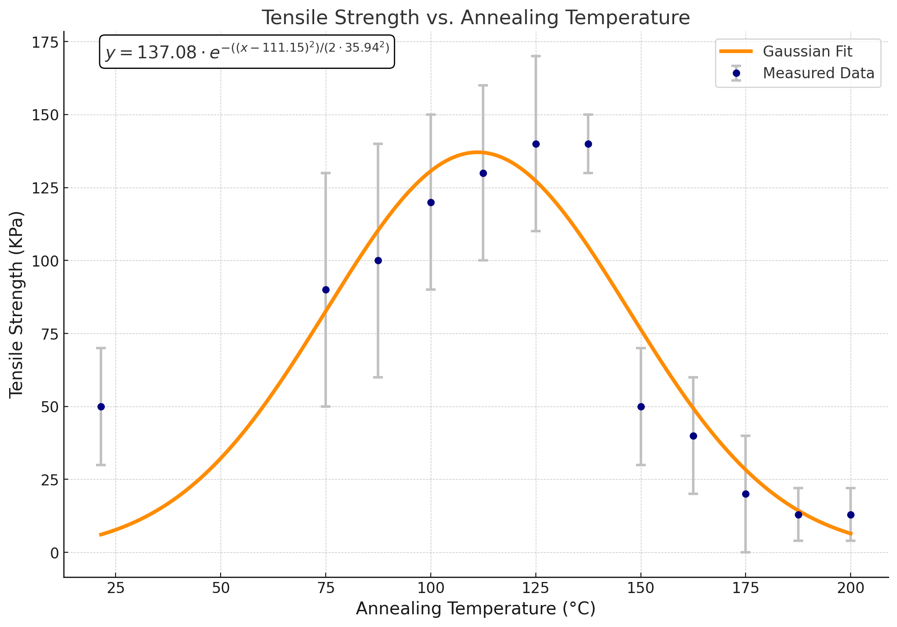
I synthesized the nylon myself by pulling the polymer film off the interface of sebacoyl chloride and hexanediamine solutions, then annealed segments at twelve temperatures from 21.5 °C to 200 °C and loaded each in 3 g increments until it broke, five trials per temperature. Strength climbs past the glass transition, peaks around 110 °C at roughly 140 kPa, then collapses toward the melting point as the segments yellow and embrittle.
The synthesis, molecular reasoning, and full data are in the paper: