Antenna Directivity
Derived the far-field radiation pattern of a dipole antenna, then built dipoles at nine lengths and traced their patterns with a NanoVNA to test the theory.
How does the length of a dipole affect its directivity? A dipole’s length sets its current distribution, the current distribution sets its radiation pattern, and integrating that pattern over the sphere gives directivity. Working from the finite-dipole current distribution, I derived the far-field radiation intensity and computed theoretical directivity across lengths. Directivity climbs as the dipole grows, peaks near 1.25λ, then collapses as the pattern breaks into side lobes.
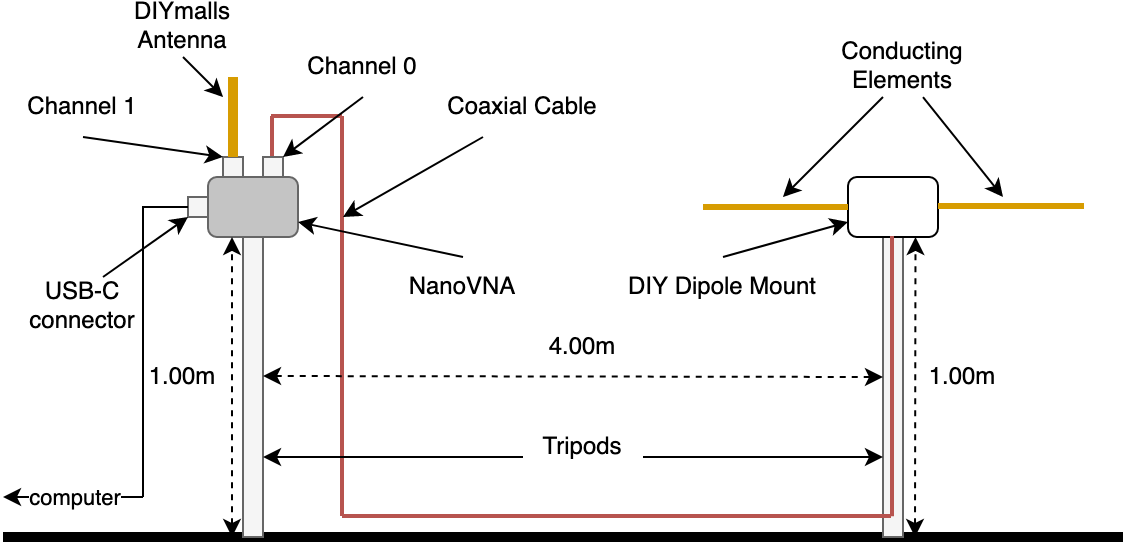
The measured patterns reproduce the theoretical trend up to the peak, with deviations around 20% attributable to systematic error.
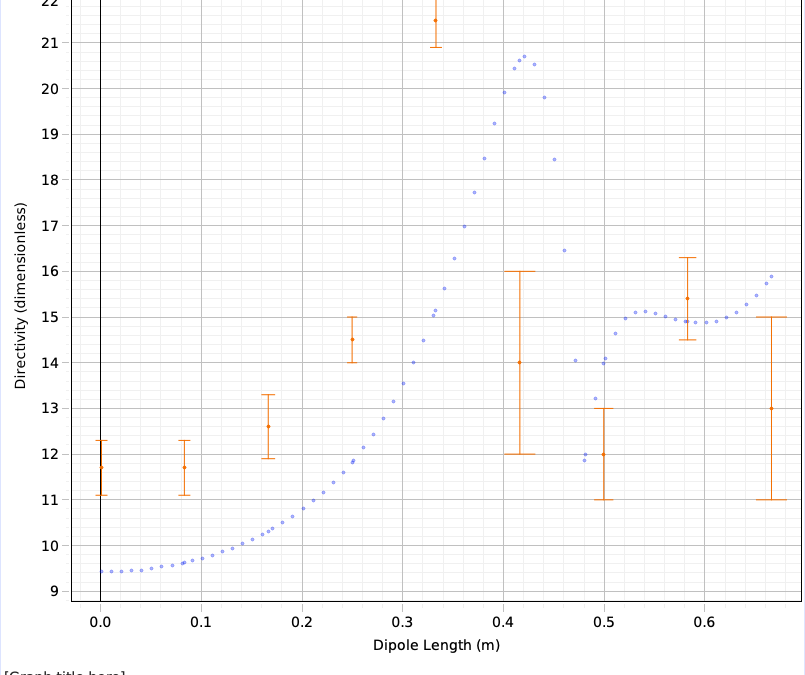
The full derivations, data, and uncertainty analysis are in the paper itself: